The Goddess of Mystery
By William Pack | Magician, Historian, and Educator, https://libraryprogramming.com/
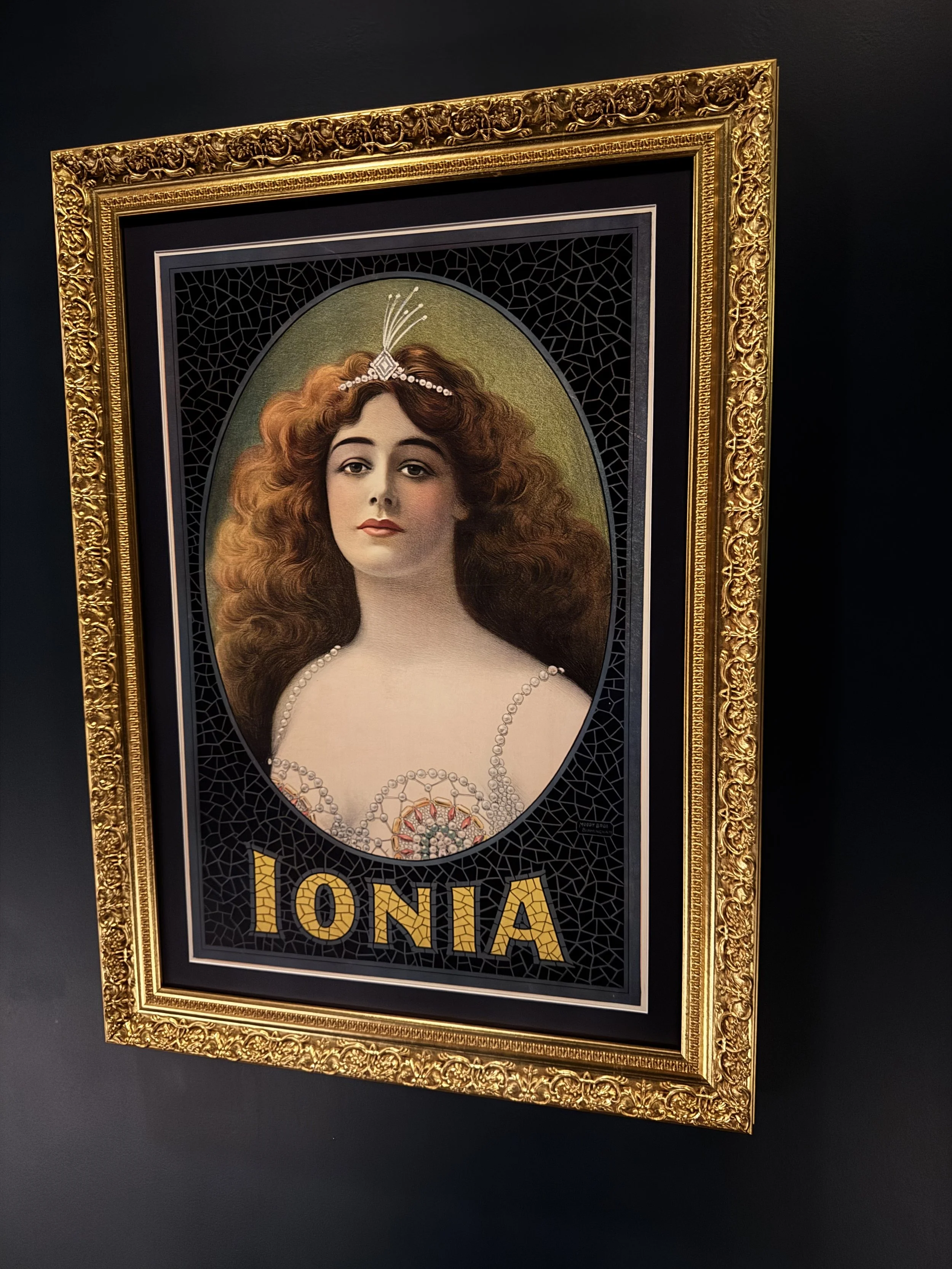
Ionia. Birmingham: Moody Bros., ca. 1910.Ionia
(Clementine de Vere)
B. December 20, 1888 – D. March 31, 1973
Clementine was born into a magic dynasty. Her father, Charles de Vere, was a prominent British illusionist who moved the family to Paris in 1892. There, he opened a world-renowned magic shop and factory that supplied the greatest performers of the day. Her mother, Julia de Vere (performing under the name Okita), was an accomplished magician in her own right, specializing in the "Oriental" style that was then the height of theatrical fashion. Growing up in this environment, Clementine was immersed in the craft from infancy.
Though her solo career lasted a mere five years, from 1910 to 1914, her legacy is immortalized through a series of stunning lithographic posters and a life story that reads like a whirlwind historical novel, stretching from the magic shops of Paris to the revolutionary streets of Moscow and finally to the sun-drenched villas of the French Riviera. In the history of magic, few figures are as draped in myth and visual splendor as Ionia.
Her first independent foray into performing was not with magic, but with animals. At the age of fifteen, she married the American circus performer and lion tamer Herman Weedon of the Bostock Circus. Under Weedon’s tutelage, Clementine became a formidable animal trainer. For several years, she toured Europe and the United States. By 1908, she was performing a double act with "Miss Elsa," which featured a dancing elephant, and by 1910, she was a celebrated "bear tamer," appearing alone on stage with six bears. In 1912, during a performance in Vienna, she survived a bear attack, a chilling reminder of the danger inherent in performing with wild animals.
In the history of magic,
few figures are as draped in myth and visual splendor
As Ionia.
Debuting in Marseille in September 1910, Clementine was reborn as Ionia. (Sometimes as the “Enchantress,” or as the "Goddess of Mystery.”) Charles De Vere closed his magic shop in 1909. This gave him time and energy to create a magic extravaganza for his beautiful daughter. He poured his technical genius and financial resources into a spectacle of grand illusions. However, the theatricality she learned in the circus was vital to the success of her magic show, which still occasionally utilized exotic animals for atmosphere. The production required six tons of equipment, a massive commitment for any touring performer of the era.
Embracing the period's obsession with "Orientalism," the show featured elaborate Egyptian-themed costumes and sets. Ionia appeared as an ancient enchantress, surrounded by a troupe of male and female assistants in equally lavish attire.
The show toured the great variety halls of Europe, from Birmingham and London to Vienna and Prague. Ionia was a sensation, but a planned 1911 American Broadway debut was tragically derailed by the sudden bankruptcy of the New York Folies Bergère.
Clementine’s personal life eventually eclipsed her stage persona. In 1913, she met Prince Vladimir Eristavi-Tchitcherine, a Russian-Georgian noble, while performing in Austria. This encounter marked the beginning of the end for "Ionia." She gave her final magical performances in Berlin in October 1913 and followed the Prince to Russia shortly thereafter. (In 1917, after her marriage to Weedon was dissolved, she married Prince Vladimir Eristavi Tchitcherine.)
Her years in Russia (1914–1918) are the source of the most enduring Ionia legends. Her father’s letters later claimed that she was trapped in a Moscow hotel cellar for three months during the Bolshevik Revolution, witnessing her massive stage equipment being pillaged by revolutionaries.
However, modern research by historian Charles Greene III suggests a more complex truth. Clementine was not in Russia to perform magic; she was there as a member of the social elite, reportedly making large real estate and luxury goods investments, potentially on behalf of her brother-in-law, the American millionaire Frank J. Godsol. While she certainly lost a fortune in the Revolution, her "disappearance" from magic was a choice fueled by her new status as Princess Clementine (a title she kept for the rest of her life, even after her 1928 divorce from the Prince).
Returning to Paris after the chaos of the Revolution, the Clementine did not return to the stage. Instead, she became a focal point for the Russian émigré community. She opened a successful Russian-themed restaurant and tea salon called Oussadba, which she operated for twelve years. Her life continued to intersect with history; she crossed paths with figures as diverse as Harry Houdini, the filmmaker George Méliès, Julia Child, and even Prince Felix Yusupov, the man famous for the assassination of Rasputin.
In 1955, she retired to a villa on the French Riviera. She lived there quietly until her death in 1973, leaving behind a son, Frank (born in 1904), and a family legacy that included her sister Elise, a famous actress.
Ionia is considered by some to be one of the most influential female magicians in the first half of the 20th century.
Today, her artistic advertising posters, produced by the Moody Brothers of Birmingham, are revered by collectors. These lithographs are considered among the finest examples of magic advertising ever created. Their vibrant colors and mystical Egyptian imagery perfectly captured the "Enchantress" persona.
Of the original 22 designs, only 11 are known to have survived into the 21st century. Because of their rarity and extraordinary beauty, they are some of the most expensive and sought-after items in the world of magic memorabilia, often fetching tens of thousands of dollars at auction.
Ionia is considered by some to be one of
the most influential
female magicians
in the first half of the 20th century.
Clementine de Vere’s career as Ionia was a brief, brilliant flash in the history of magic. While other performers spent decades on the circuit, she managed to achieve immortality in just five years. She was a woman who navigated three distinct worlds: the perilous floor of the circus ring, the majestic stage of the grand illusionist, and the high-stakes salons of European royalty.
Her life was recently the subject of a definitive biography by magic historian Charles Greene III titled Ionia: Magician Princess, Secrets Unlocked, which unraveled many of the myths surrounding her disappearance from the stage.


